Author Rob Explores Sicily

Author Rob C Blyth and his wife went to check out some of the locations he intended to use for his new novel set in early 20th century Sicily. This article was adapted for our village magazine - The Rousdoner - July - August 2026.
Four years in the development
We were on the west side of Sicily, having flown into Palermo's Falcone-Borsellino airport the day before. Three years earlier, we had travelled to the east of Sicily. Writing requires significant research to nail down a sense of time and place, and this was the intention behind this trip. The characters and storyline were complete; this was to be a writer’s denouement for the book, titled—Promises Beyond Shadows—The Advocate. No spoiler alert, although a few titbits are offered along the way.
Visiting the wonderful Italian island of Sicily, so proud of its heritage, meant stepping off the well-trodden tourist paths and deciding whether locations fitted, a bit like a film producer seeking the best sites for shooting. I did not want to write a book about the Mafia, but rather about a family and the inescapable rigours imposed on peasants before the First World War—of course the inescapable happened and one cannot leave out this ancient organisation that impacted then, and today on it's people.
Sicily's capital - Palermo
The first stop took in Monreale (pronounced Mon-ray-ally), where the book opens; the cathedral provided a unique setting for the opening scene. Set outside the capital, the cathedral rests above Palermo, with the docks visible in the distance, yet below the mountainous hills of the Cammarata, where brigands of the past hid from the authorities whilst on the run from the law.
A trip the next day with Trenitalia railway from Ficarazzi into Palermo proved a wiser decision than using a hire car. The heat in May was a healthy 25˚ c.
The principal character, Ludovico Randazzo, becomes is destined to become an advocate (an Italian lawyer) in Palermo.


Marina, one of the Des Palmes receptionists, talked about Mafia meetings, which led to a trip to Palermo’s equivalent of Waterstones. Unfortunately, the book Marina had recommended was unavailable and had to be ordered from a well-known online retailer.
The old storico, or historical centre, became an essential visit, as it offered more details connected with the preconceived story drawn up back home. The thriving
fish market in Vucciria became the location for Guilia and her father's business helped by Ludovico who supported their venture after their family had been assaulted by criminals.

Fontana Murata
We spent two days on the beautiful farm at Fontana Murata with Paola and her housekeeper, Mariella, enjoying the best local food and wine of our short trip. Paola explained that the landowners had formed a cooperative and refused to pay the local Mafia. In retaliation, the Mafia dragged burning bales across the field, destroying the wheat crop. Sicily had once been Rome's breadbasket, from which pasta and wonderful breads were made.

The farm had been bought by Paola’s great-grandfather from Barone Paino, whose family had owned the land for several centuries. Many of the sources I consulted explained the early rise of Mafia dominance. Distant landowners relied on people to look after their land, and when the peasantry rebelled, organised bandits agreed to protect the landowners for a fee. The idea of protection soon developed along these lines, and this coercive activity persisted.
But Fontana Murata would not be used as the setting for my story and had to be relocated. Sorry, Paola. A fiction writer can do this, shaping material without real names, although respect remains important.
After a hearty Mediterranean breakfast of meats, cheeses, eggs, croissants, cake, and orange juice, plus, of course, wonderful Italian coffee, we set out to see the local caves a short distance away. Unfortunately, the location was unsuitable for dumping bodies, being too open and not high enough. The body-dumping scene would have to wait for a more suitable landscape. The Mafia used many such cracks and crags in rocks to drop their victims, termed Lupara Bianca—implying lost forever. The book is no tidy romance.
The reader might wonder—why go to Sicily to find locations? Travel during the period 1900-1910 required some cross-checking and visiting locations in order to capture the ambience and sense of scale. Inevitably, this meant swapping locations for those ones more plausible.
It might be of interest to note the word mafia had wide interpretation and different spellings. Originally mafia could be associated with beauty or impudence, although first used in a document in 1838 to designate criminal groups. Originally members of groups were called fratuzzi (little brothers) or fratellanze (brotherhoods). By the second part of the 19th century mafia were introduced as the Cosa Nostra (our thing).
Cars were scarce, and the rail system, reasonably developed thanks to Briton Benjamin Ingham (in part). British trade with Sicily was strong in the 18th and 19th centuries, with wine export and citrus fruit for the navy.
Peasants relied on carts and donkeys to reach towns set high on hills, jourmneys took time and could be perilous. The population remained widely dispersed across awkward terrain.
Mafia Bosses
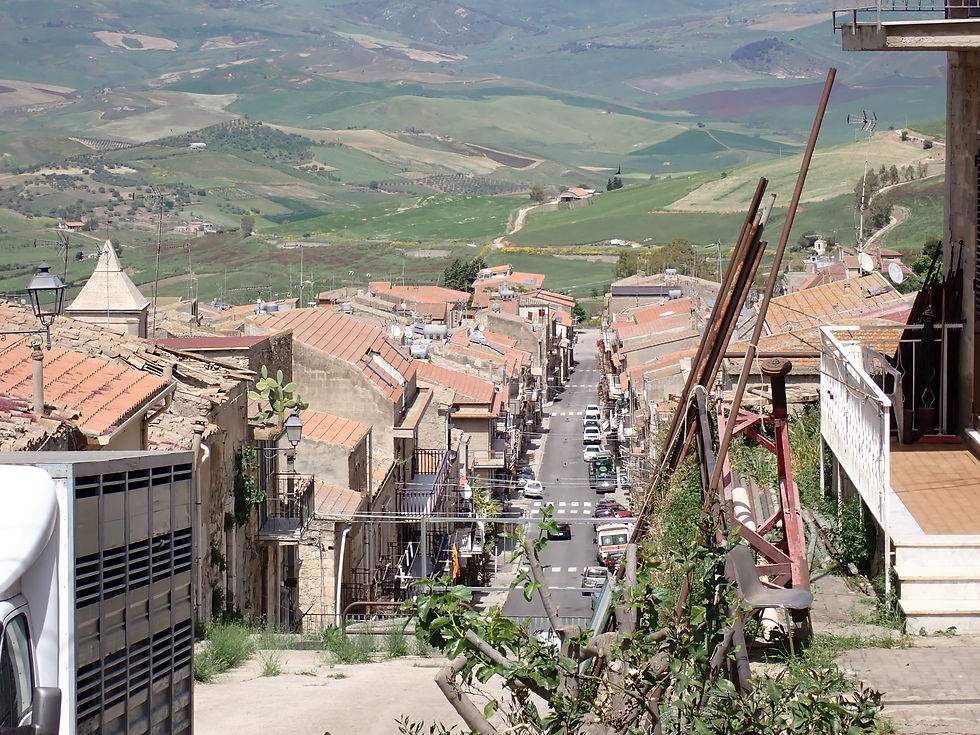
The old Arabic town of Villalba remained the prime focus for scheming Calogero Salvatore fictionalised from the real-life Mafia boss of bosses, Calogero Vizzini. It is generally accepted that Vizzini helped the US Army after the Allied invasion in 1943, where the Mafia had little love for fascism under Benito Mussolini.
No story can be told without the Catholic Church being involved, and there is a clear partnership between the Church and the Mafia.
Weddings allied to the church are a necessity for a good story. Many churches had beautifully appointed marble interiors, exuding wealth.
The list of planned towns and villages led us south to our base just above Hellenic Agrigento. Some roads proved unsuitable. Driving toward San Biagio, we found the road blocked. A detour down a lesser road reminded us that not all roads had been upgraded.

A planned mini-picnic alongside the beautiful Lago Magazzolo near Alessandria della Rocca proved a short-sighted failure. The road narrowed, with a foreboding central island of raised greenery. The sound of bushes rasped against the car’s side, and fear of becoming stuck necessitated a U-turn in a field. Passing Sicilians, albeit few, looked on, and one could only imagine their thoughts and expressions as two ignorant tourists navigated unassailable terrain. The Lago (lake) was a reservoir formed by damming the Magazzolo river. A major part of the story takes place in this region, which required a major rethink.

Caltanissetta
Our last day took us to the major town and region of Caltanissetta.
Castle (castello) Pietrarossa projected towards the sky like a damaged molar; a few bricks remained, forming a crenellated feature high above Santa Maria degli Angeli. Although not a church today, the Franciscan convent used building materials from the 9th-century castle, hence the ragged outline. The curator invited us in and beckoned us to follow him down some steps, a hint of anticipation in his voice, his torch extended as darkness prevailed in a low-roofed, narrow passageway. This was the putridarium. Two rows of stone seats revealed holes—the natural assumption—a communal latrine. It proved more macabre.
The curator explained that dead monks were placed on the seats and their decomposing organs were allowed to drain through the holes until they could be repurposed as desiccated husks of bones for saintly relics. No doubt this served an ancient industry, for many who purchased a relic saw it as an investment that connected them to the divine.
Behind the modern building of Santa Maria degli Angeli lies a cemetery. If one has never visited a Catholic cemetery in Italy, it is highly recommended. It carries more information and grandeur than most UK equivalents.

Following a successful quest to find the courthouse where our protagonist defends the unsavoury Salvatore at the behest of his uncle, Bishop Santoro we found the site of the old prison identified at Via Tumminelli. Standing alongside the old walls, pondering the old outer shell with newer windows, satisfied that this was the right place for Salvatore, a kindly man stopped. Out came mobile phones and translation apps. For the next thirty minutes, a duet of messages typed onto small screens, combined with voice input, connected with one Carlo Sorbetto. Carlo explained that he was researching the medical history of Caltanissetta. Kindness prevailed, and we two exchanged addresses as keen historians.

And so came the end of a busy week, trailing along back streets, driving between high, mountainous hills that exuded a beauty that imposed considerable hardship on the Allied army back in 1943.
And now to complete the story back in the UK for 2027.
R.C.Blyth has published Fatal Contracts and A Hard Act to Follow, available from Amazon Books.
His latest, Caught in the Crossfire, is set in New York, awaiting publication this year. rcblyth.com


Comments